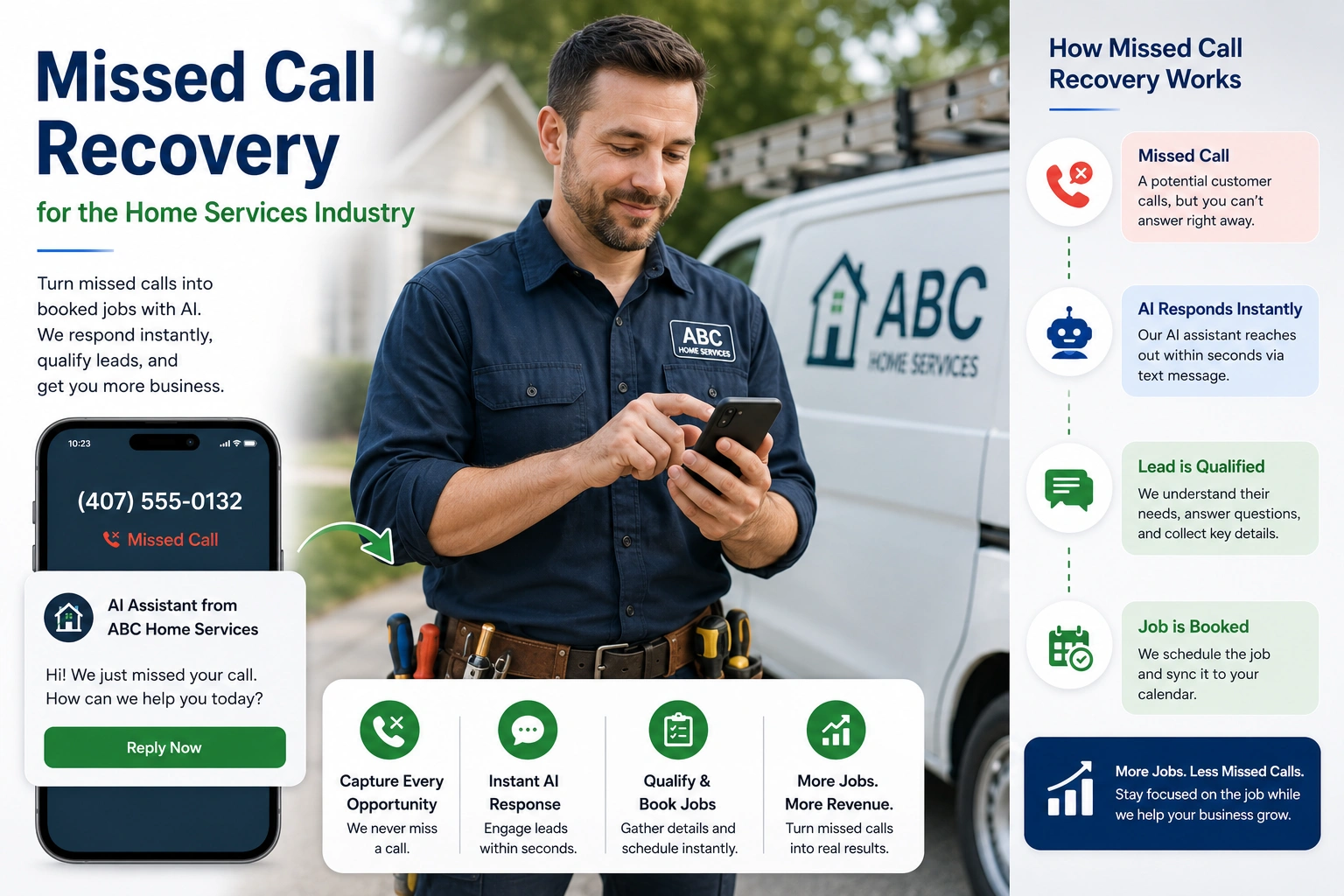
In home services, a missed call is rarely just a missed conversation. It can be a homeowner with an urgent repair, a high-value quote request, a new customer looking for availability, or a returning client ready to schedule. Missed-call recovery helps your business respond quickly when a call goes unanswered so the opportunity is not lost to a competitor.
What is missed-call recovery?
Missed-call recovery is the process of automatically following up with callers when your business does not answer the phone. Instead of leaving the caller waiting, the system can send an immediate text message, start a web chat, trigger an AI voice agent, collect job details, or route urgent requests to the right person.
The goal is simple: respond while the customer is still interested and before they contact another provider.
How unanswered calls become lost bookings, leads, or clients
Most customers do not treat one unanswered call as the end of their search. They often move to the next company, request a quote from a competitor, or book with whoever responds first. That means an unanswered call can quickly become a lost job.
Missed calls can create several business problems:
- Lost bookings: The customer needed service now and booked with another provider.
- Lost leads: The business never captured the customer’s name, phone number, service need, or urgency.
- Lost clients: A first-time caller could have become a repeat customer but never entered your pipeline.
- Lower ad ROI: Paid traffic, Google Business Profile clicks, and local SEO efforts are wasted when calls go unanswered.
- Operational blind spots: The business may not know which missed calls were emergencies, high-value jobs, or simple questions.
Why missed-call recovery matters in home services
Home service businesses are especially vulnerable to missed-call losses because calls often happen while teams are in the field, driving, serving customers, or handling active jobs. The person calling may not wait for a callback.
This is especially true for industries such as HVAC, plumbing, electrical, roofing, appliance repair, locksmith services, pest control, cleaning services, and landscaping. In many of these trades, the caller may be dealing with a time-sensitive problem and may contact multiple companies within minutes.
How a missed-call recovery workflow works
A strong missed-call recovery workflow should respond immediately, capture useful information, and make it easy for the customer to take the next step.
- Call goes unanswered: The customer calls but your team is unavailable.
- Instant response is triggered: The system sends an automatic text-back or starts an AI-assisted follow-up.
- Customer is engaged: The message asks how the business can help and invites the caller to describe the service need.
- Lead details are captured: Name, phone number, address, issue, urgency, and preferred appointment time can be collected.
- Next step is offered: The customer can request a callback, book an appointment, or receive answers to common questions.
- Your team is notified: Staff receive the lead details so they can prioritize follow-up.
Want to see how missed-call recovery would work for your home service business?
Where AI voice agents and web chat fit in
Missed-call recovery becomes more powerful when it connects with AI voice agents, virtual assistants, and web chat. These tools help continue the conversation even when your team cannot answer live.
AI voice agents
An AI voice agent can answer calls, ask qualifying questions, collect details, explain next steps, and route urgent requests. This is useful when call volume is high, after-hours calls come in, or staff are already helping other customers.
Automated text-back
A missed-call text-back can respond within seconds with a message such as, “Sorry we missed your call. What service do you need help with today?” This keeps the customer engaged and gives them an easy way to respond.
Web chat
Web chat gives visitors another way to request service, ask questions, or start a booking conversation without calling. This is valuable for customers who are browsing after hours or comparing providers online.
Examples of missed-call recovery by trade
The recovery workflow can be adapted to the type of service business and the urgency of the request.
- HVAC: Capture no-cooling, no-heat, maintenance, and replacement inquiries.
- Plumbing: Prioritize leaks, clogs, water heater issues, and emergency service requests.
- Electricians: Collect details about outages, panel work, lighting, repairs, and installation needs.
- Roofing: Capture inspection requests, storm damage inquiries, leaks, and estimate requests.
- Locksmiths: Route urgent lockouts faster while collecting location and service details.
- Appliance repair: Gather appliance type, brand, issue, and preferred appointment window.
What to track after implementing missed-call recovery
To measure performance, track both response activity and business outcomes.
- Number of missed calls
- Number of automatic responses sent
- Response rate to missed-call text-backs
- Recovered leads
- Booked appointments from recovered calls
- Average response time
- Estimated revenue recovered
These metrics help you understand whether unanswered calls are costing you business and how much opportunity your recovery system is bringing back into the pipeline.
What to do next
If your business receives calls while technicians are in the field, after hours, during lunch breaks, or when staff are already helping customers, missed-call recovery can help protect revenue and improve customer experience.
Start by reviewing how many calls go unanswered each week, when they happen, and how quickly your team follows up. Then consider adding an automated recovery workflow that responds instantly and captures the customer’s intent before the opportunity disappears.
The right system does not just reduce missed calls. It helps convert more of the demand you already worked hard to generate.