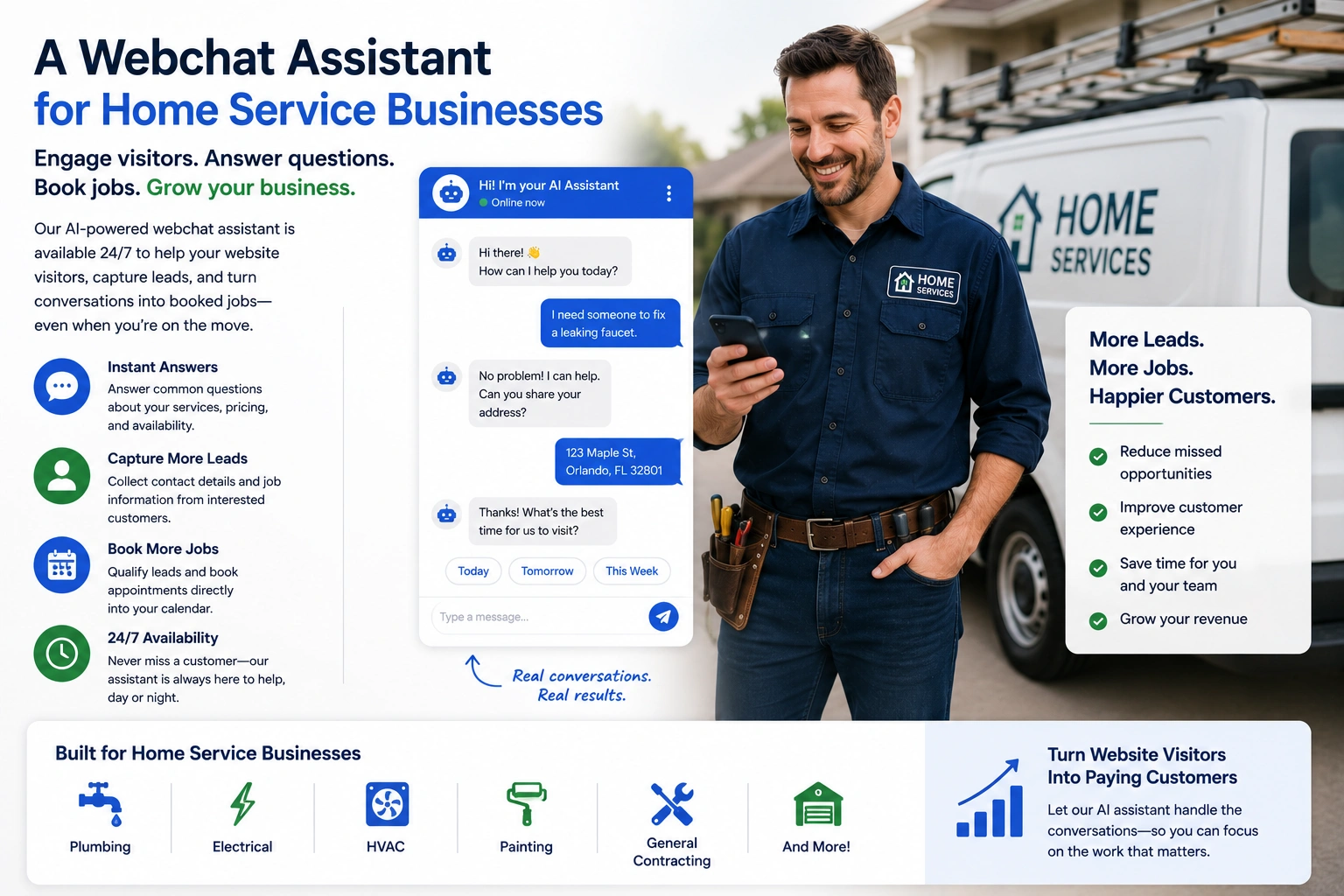
A website chat assistant helps home service businesses engage visitors while they are actively looking for help. Instead of leaving prospects to browse alone, fill out a static form, or leave the site without contacting you, a chat assistant can answer questions, collect details, qualify the request, and guide the visitor toward the next step.
Why website chat matters for home service companies
Home service customers often visit your website when they have a specific need: a broken AC unit, a leaking pipe, an electrical issue, a pest problem, roof damage, appliance trouble, or a project they want quoted. At that moment, they are deciding whether your company is responsive, trustworthy, and easy to work with.
A chat assistant gives those visitors an immediate way to ask questions and request help. It reduces friction, keeps them engaged, and helps your business capture opportunities that might otherwise leave without calling or submitting a form.
What a website chat assistant can do
A well-designed chat assistant acts like a front-line digital responder on your website. It can help visitors move from interest to action by asking the right questions and collecting the information your team needs.
- Answer common service questions
- Confirm whether you serve the customer’s area
- Capture name, phone number, email, and address
- Identify the service category or problem type
- Ask about urgency, timing, and job details
- Guide visitors toward requesting an estimate or booking service
- Provide after-hours engagement when staff is unavailable
This creates a smoother experience for the customer and gives your team better information for follow-up.
Benefits of a chat assistant for home services
Home service businesses benefit from chat assistants because they support the moments when customers are already looking for help. Instead of relying only on phone calls or contact forms, chat gives prospects another low-friction way to start a conversation.
More captured website leads
Many website visitors are not ready to call immediately. A chat assistant gives them a simple way to ask a question or share their issue, helping your business capture more leads from the traffic you already have.
Faster customer response
Response speed matters. When a customer gets immediate guidance, they are less likely to leave and contact a competitor.
Better lead quality
Instead of receiving vague form submissions, your team can receive structured information about the customer, location, service need, urgency, and preferred timing.
Reduced administrative friction
The chat assistant can handle repetitive early questions, allowing your office team to spend more time on qualified opportunities and booked jobs.
Want to see how a chat assistant can capture more leads from your home service website?
How chat improves lead capture and qualification
Static website forms often ask for basic information, but they do not guide the customer through a useful conversation. A chat assistant can ask follow-up questions based on the visitor’s answers.
For example, an HVAC visitor may say their AC is not cooling. The assistant can ask whether the system is running, whether it is an emergency, what city they are in, and when they would like service. A plumbing visitor may report a leak. The assistant can ask whether water is actively leaking, where the leak is located, and whether immediate help is needed.
This helps your team understand priority and context before making contact.
Why chat is valuable after hours
Many homeowners search for help outside normal business hours. They may be researching service providers at night, on weekends, or during a problem that cannot wait until morning. If your website only offers a phone number and a form, some of those visitors may leave.
A chat assistant keeps your website active even when your team is not available. It can collect the customer’s details, identify the issue, and help your business follow up with better context.
How web chat becomes a segue into AI voice virtual assistants
Web chat is often the easiest first step into AI-assisted customer communication. It helps a business get comfortable with automated conversations, structured lead capture, and customer qualification before expanding automation to phone calls.
Once a business sees how chat can capture website leads, the next logical question is: what happens when customers call instead of typing? That is where AI voice virtual assistants become valuable.
A chat assistant and an AI voice assistant can use similar workflows:
- Greeting the customer professionally
- Identifying the service needed
- Capturing contact information
- Asking qualifying questions
- Determining urgency
- Routing or escalating when needed
- Preparing the request for follow-up or scheduling
The difference is the channel. Chat helps with website visitors. AI voice helps with inbound callers. Together, they create a stronger front-end response system for home service businesses.
Why both chat and voice work better together
Some customers prefer to type. Others prefer to call. Some visit your website first, while others call directly from Google, ads, directories, or referrals. Using both web chat and AI voice coverage helps your business capture more opportunities across customer preferences.
- Chat captures visitors who are browsing your website
- AI voice captures callers when your team cannot answer
- Both can qualify requests using consistent questions
- Both can reduce missed opportunities during busy periods
- Both can support after-hours lead capture
This is especially useful for trades where demand can spike quickly, such as HVAC during heat waves, plumbing during emergencies, roofing after storms, and pest control during seasonal surges.
How to implement a chat assistant effectively
The best chat assistant is not generic. It should be configured around your services, service area, lead flow, and operational priorities.
- Define the services you want the assistant to support
- Identify the information your team needs for follow-up
- Create workflows for urgent and non-urgent requests
- Decide when the assistant should recommend calling or scheduling
- Connect the lead flow to your team’s preferred follow-up process
- Review conversations and improve the assistant over time
Start with the most common customer questions and service requests. Then expand the assistant as you learn where it creates the most value.
Frequently asked questions
Can a chat assistant replace my website contact form?
It can supplement or improve the contact form experience, but it does not have to replace it. Many businesses use both: a form for visitors who prefer it and a chat assistant for visitors who want immediate interaction.
Will customers use chat for home services?
Yes, especially when they have quick questions, want to confirm service availability, or are not ready to call. Chat gives them a convenient way to start the conversation.
Is chat better than AI voice?
They solve different parts of the same problem. Chat helps website visitors. AI voice helps callers. For many home service businesses, the strongest approach is to use both.
Can chat help emergency service businesses?
Yes, but the workflow should be designed carefully. The assistant should identify urgency quickly and guide high-priority customers toward the right next step.
What to do next
If your website receives traffic but does not consistently convert visitors into leads, a chat assistant can help close that gap. It creates a more responsive website experience and prepares your business for a broader AI assistant strategy that includes voice.
The best next step is to map your most common website inquiries and phone call types, then build a simple workflow that captures the information your team needs to turn conversations into booked jobs.